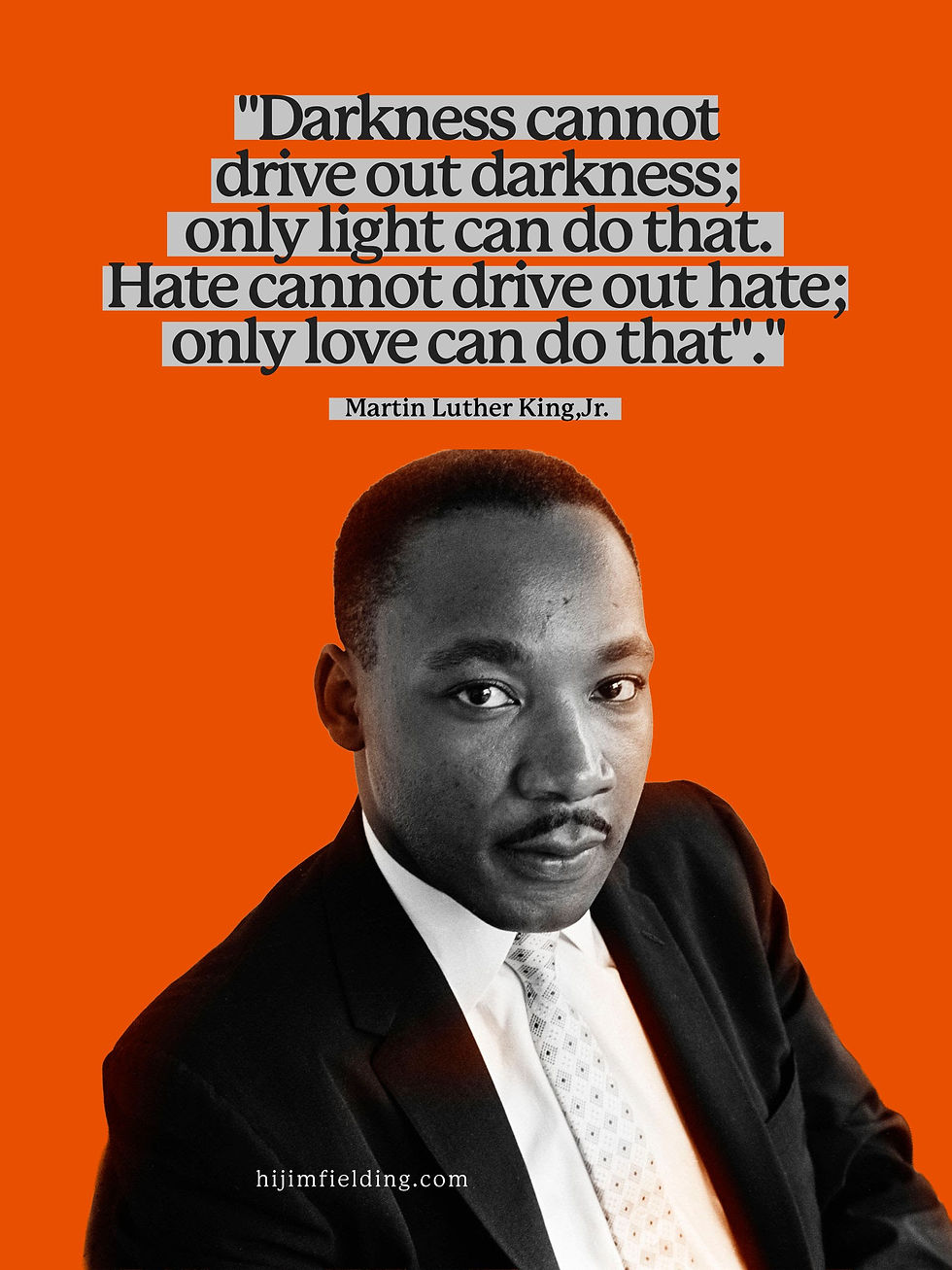
Dr. King’s Legacy Isn’t a Holiday. It’s a Standard. Celebrating the life of a True Leader and Visionary.

“The time is always right to do what is right.” — Dr. Martin Luther King, Jr.
Every year, Martin Luther King Jr. Day arrives with the familiar rhythm of remembrance: a few iconic speeches, a handful of quote graphics, maybe a day of service, and then… back to business.
But Dr. King didn’t give his life for a long weekend.
He gave his life trying to move a nation toward something bigger than comfort and tradition—toward conscience.
And if we’re honest, that’s where his legacy still feels challenging, even painful. Because it’s easier to admire Dr. King than it is to practice what he preached.
It’s easier to celebrate his bravery than it is to confront what bravery requires of us now.
Dr. King’s real message was never “be nice.”
One of the most misunderstood things about Dr. King is that people mistake his commitment to nonviolence as softness.
Nonviolence wasn’t weakness.
It was strategy.
It was discipline.
It was courage with its sleeves rolled up.
He wasn’t asking America to feel guilty. He was asking America to grow up.
He spoke clearly about injustice, power, poverty, racism, war, and the ways systems get protected by silence. And he did it knowing it would cost him: relationships, security, peace, and eventually his life.
Which is why one of his most haunting truths still lands with full weight today: “A time comes when silence is betrayal.” — Dr. Martin Luther King, Jr.
That quote isn’t comfortable. It isn’t meant to be.
It’s not just a moral statement. It’s a leadership standard.
The legacy: moral courage, organized action, and disciplined hope.
Dr. King’s genius wasn’t only in his oratory. It was in his ability to translate moral clarity into collective action, bridging faith, activism, labor, students, and everyday citizens into a movement that could not be ignored.
He didn’t just dream. He organized.
He didn’t just speak. He mobilized.
And he didn’t ask for change politely. He applied pressure—strategically, consistently, and publicly—until the country had to reckon with itself.
That’s something we forget when we soften him into a “unity” mascot. Dr. King absolutely believed in unity—but never as a substitute for justice.
The people around him mattered too
Part of honoring Dr. King responsibly is remembering he was not a solo act. Movements are ecosystems. And Dr. King was surrounded by courageous leaders—some visible, some intentionally erased from the spotlight.
One of the most important was Bayard Rustin.
Rustin was a brilliant strategist, a committed practitioner of nonviolence, and a key architect of the movement’s most famous moment: the 1963 March on Washington for Jobs and Freedom.
He was also openly gay, a fact that made him “inconvenient” to some allies at the time, and therefore easier to minimize, sideline, or keep behind the curtain.
If you want a modern leadership lesson, it’s right there:
Even justice movements can mirror the exclusions of the world they’re trying to change.
Dr. King’s legacy includes his light—and also the people who helped build the stage he stood on.
John Lewis: the courage to keep going
And then there’s John Lewis, a man whose life became a long, living extension of Dr. King’s teachings.
Lewis wasn’t just inspired by Dr. King; he embodied the movement’s most demanding principle: nonviolent resistance in the face of very real violence.
He served as chairman of SNCC and worked to maintain a relationship between SNCC and Dr. King’s SCLC even when it was unpopular.
That kind of leadership is rare: the leadership that refuses purity tests, refuses ego contests, and stays committed to coalition, even when coalition is messy.
John Lewis taught that you can be both furious and disciplined. Both exhausted and faithful. Both bruised and unbroken.
He proved that the movement wasn’t a moment. It was a lifetime.
What Dr. King asks of us now
So how do we honor Dr. King without turning him into a decoration?
We start by telling the truth:
Dr. King’s dream wasn’t just about racial integration. It was about human dignity.
It was about equal access to opportunity.
It was about democracy that actually functions.
It was about moral courage from leaders who don’t hide behind “neutrality” when neutrality protects harm.
And it was about resisting the seduction of power for power’s sake.
Dr. King didn’t want our admiration. He wanted our participation.
Which brings us to the most modern part of his legacy:
The work is never finished.
That’s not pessimism. It is responsibility.
Young leaders today are still carrying the torch
When I look around right now, I don’t just see division and unrest.
I also see young leaders doing what young leaders have always done: standing up faster than the people in charge.
In classrooms. In city streets. In statehouses. In small towns. In boardrooms. In faith communities. On campuses. Online.
They are organizing around civil rights, voting rights, equality, safety, education, climate, and community care, often with fewer resources, more scrutiny, and a constant barrage of cynicism.
And what I want to say to them is this:
Dr. King would recognize you.
Not because your tactics match the 1960s perfectly. They won’t.
Different era, different tools.
But because the core ingredients are the same:
moral clarity
collective action
disciplined courage
and the refusal to accept “this is just how it is” as an answer
A personal note from where I sit
As a white American, I don’t experience this history the way Black Americans do.
And I never will.
So my role on MLK Day isn’t to center myself in a story that isn’t mine.
My role is to listen, learn, amplify, and act.
To honor Dr. King not with performance, but with practice.
To refuse comfortable silence when people’s rights, safety, voices, and dignity are at stake.
Because leadership isn’t proven by what we post on holidays.
Leadership is proven by what we protect on ordinary Tuesdays.
So today, I’m sitting with two Dr. King truths that will not let me off the hook:
They aren’t competing ideas.
They’re a matched set.
A challenge.
A standard.
A legacy.
And if we’re serious about honoring him, we won’t just quote him.
We’ll become the kind of citizens and leaders who help his work continue.
In Community and Conversation,
Jim